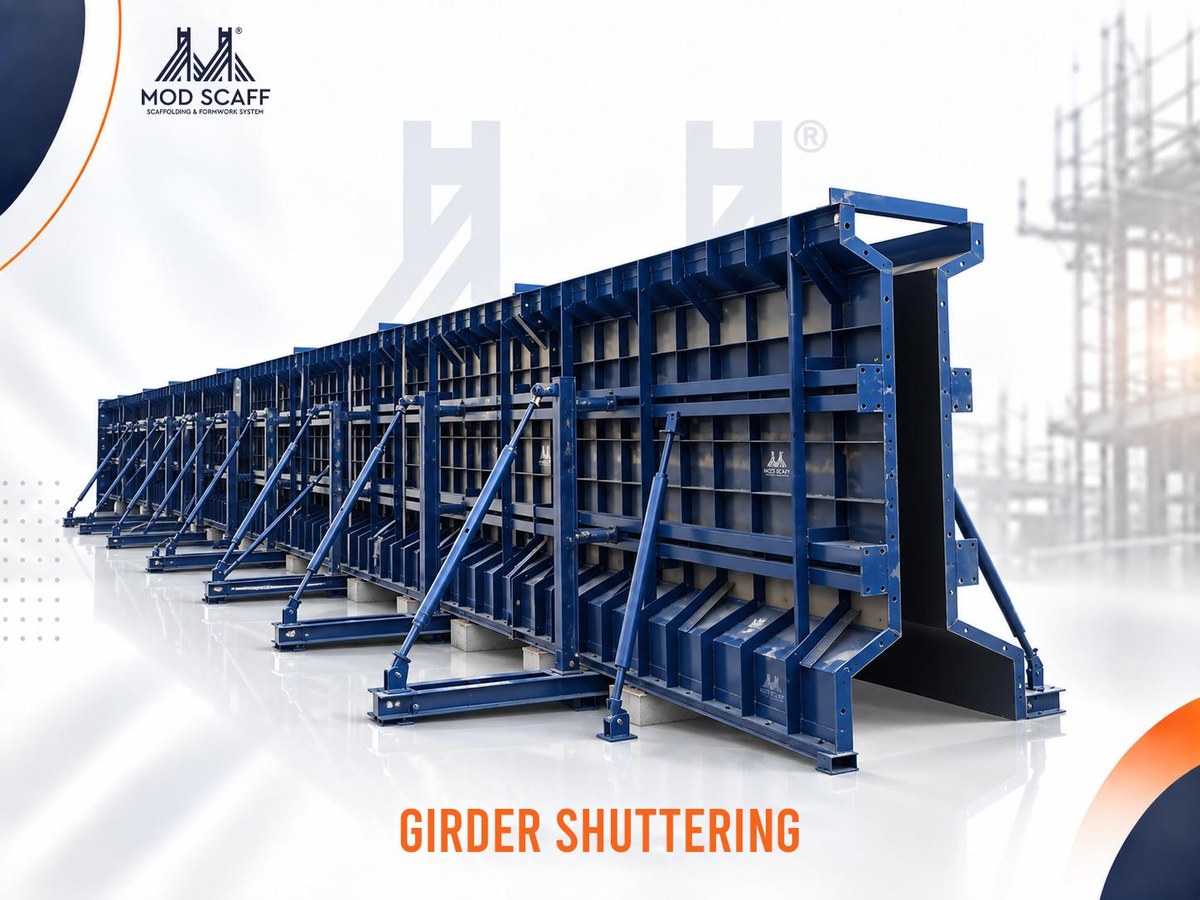
A box girder is what gives long-span bridges their strength and stiffness. Here's how the design evolved, and the three main ways box girders are built on site.
A box or tubular girder is a girder that forms an enclosed tube with multiple walls, unlike an I-beam or H-beam. The term "box girder" is generally used when the cross-section is rectangular or trapezoidal, and the design is especially common in long-span bridge construction, where torsional stiffness and load distribution matter most.
MOD SCAFF manufactures Girder Shuttering — the formwork used to cast these structures — at its Faridabad, Delhi/NCR facility, built to customer drawings using high-quality raw material for durability and rust resistance under adverse site conditions. Every batch is tested against defined parameters to confirm it meets international quality standards.
How Box Girder Design Evolved
Formwork traces back nearly 2,000 years to Rome, where the dome of the Pantheon was cast using lightweight concrete — you can still see the moulding effect of the formwork on its underside today. It wasn't until the end of the 19th century, with the invention of reinforced concrete, that mass concrete construction took off, driving the evolution of the formwork systems used today.
As bridge spans and deck widths increased over time, engineers needed to tie the beams and bottom slabs together to maintain the overall geometry of the structure — and that requirement is what led to the evolution of the box girder as we know it.
Types of Box Girder Construction
Box girders are typically built from prestressed concrete, structural steel, or a composite of steel and reinforced concrete, and are particularly well-suited to longer spans and wider decks. There are three main construction methods used on site:
- Cast-in-situ construction — the box girder is cast in place using falsework supports, which are removed once the concrete has gained sufficient strength.
- Segmental construction — used for segmental bridges, where 2.5–3.0 metre segments are precast in a casting yard, transported to site by trailer, and installed using cranes.
- Incremental launching — gantry cranes are used to place new segments onto completed sections of the bridge until the full superstructure is assembled.
Need formwork or scaffolding for your project?
Talk to MOD SCAFF's engineering team about your site requirements — production capacity of 800–1,000 tons/month, ISO 9001:2015 certified.